Thursday, December 15, 2011

Kaohsiung, Taiwan Trip 2011

My husband and I have a strong liking for this place, Kaohsiung, probably because of the hotel's location which is just less than 5 minutes walk from the railway and MRT stations.  The bus stations are also around the area and food outlets are plenty.  The hotel is also within walking distance to Nanhua Night Market [hotel is on Nanhua Street] and Liouhe Tourists Night Market.  The hotel we stayed is also the best hotel during this holiday trip because of its location and friendly hotel service.  The rates are also very affordable.  We extended our stay to four nights and made a day trip to Tainan instead of staying at Tainan.
If I do visit Taiwan, Kaohsiung will be my first stop if I can get a direct flight there.  It's so convenient place with MRT routes covering all the spots you would like to visit as a tourist.
One of the many bridges over Love River
Kaohsiung Railway Station
The city and most tourist spots are also well linked with the MRT Orange and Red Line service and it is easy to explore most areas by foot.
Communication wise, we had no problem as the local Taiwanese dialect [Minnan dialect] and Mandarin are widely used.  There is a sense of closeness when we speak the same dialect.  
Weather wise is considered good with occasional rain but sky is hazy all day for days when we were at Kaohsiung.
Places we visited are:
Cijin Island - Take MRT Orange line to Sizihwan Station, leave the station at Exit 1 and walk a short distance [8 minutes] to the Gushan Ferry Pier.  Take the ferry to the island [about TWD 15 one way] just opposite, journey is about 10 minutes.
Gushan Ferry Station - All sorts of shaved ice and snacks are served around the area.  Visitors can sample all of the street foods and cool off from the heat.
Cihou Tianhou [Matsu] Temple - about 5 minutes walk from Cijin ferry terminal along Miaocian Road, Cijin Island.  This temple has its history way back to 1673, is the oldest and most historic temple in Kaohsiung city.  Designated as a National Grade 3 historic heritage site.  The engravings, clay sculptures, porcelain works of the temple are classic and refined.
Cijin Island waterfront
Ferry at Gushan Ferry Pier at Binhai Road, Sizihwan
Trishaws on the island providing leisure rides
 around the vicinity
Cihou Tianhou [Matsu] Temple, Cijin Island
Beautiful temples around Cijin Island
Beautiful joss paper burning furnace at Cijin Island
Coastal area of Cijin Island, beach areas are not well kept
Kaohsiung Harbour - After the deregulation of the Kaohsiung Port area, a landscape development project soon followed.  The area has been transformed completely.  The former west side harbour railway has been changed to the most romantic bike pathin Taiwan.  While riding against the wind on a bicycle, riders are enchanted by the scenic port views.
Former Banana Warehouse - This colossal warehouse by the loading dock was built by the Kaohsiung Harbour Administration in the early days for banana storing and loading as an effort to support Taiwan's banana exports.  Now various items are displayed at the warehouse.


Holiday cruise just arrived at the harbour bringing tourist to the Banana Warehouse
Ample items on display at Banana Warehouse


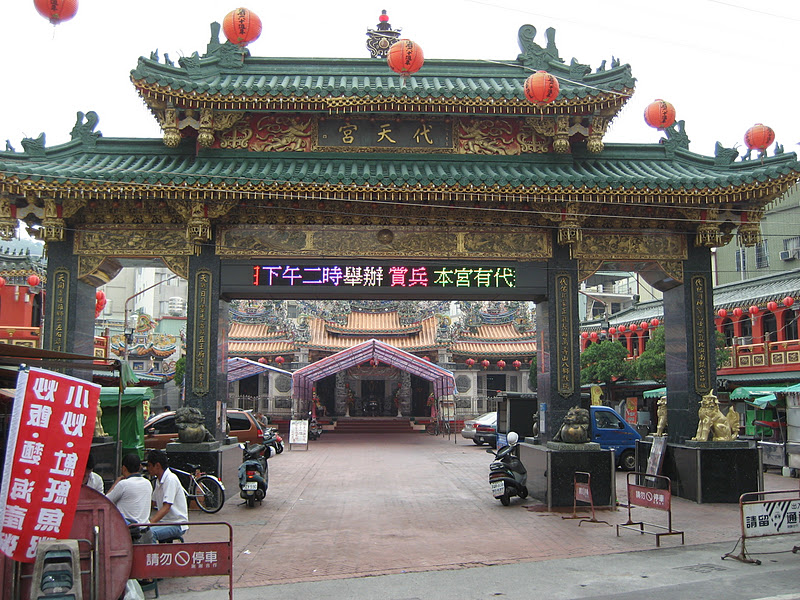
Daitiengong temple at Sizihwan district with foodstalls lining both sides of temple
Museum of Labour - Take the Kaohsiung MRT Orange line to Yanchengpu Station, leave the station from Exit 1, and turn right at Dayong Road.  The museum is just by the Pier 2 Art Center.
Most of the items on display are transformed from recycled items.  The Kaohsiung Museum of Labour is located at Taiwan Sugar Corporation's C4 warehouse, just next to the Pier 2 Art Center.  It is the first museum in Taiwan to feature Taiwanese labourers and has devoted itself to the preservation of the cultural value of Taiwan's labourers.  The museum manages to maintain Kaohsiung's image as an industrial city from the perspective of labour culture and aims to share their achievements with visitors, especially labourers.
Museum of Labour - must see place
Art Piece at the side Pier 2 Art Center


Rose Cathedral - Take MRT to Central Park Station then a Shuttle Bus R 20 to the cathedral.  The cathedral is also quite nearby to Love River at Jianguo 4th Road.  This Catholic church is the only church that practices services in a foreign language in the entire Kaohsiung area.
Built during the period of Emperor Sian Fong of the Cing Dynasty, Kaohsiung Holy Rosary Cathedral Minor Basilica is the first and largest cathedral in Taiwan and one of the three major basilicas in Asia.  It is an aesthetically pleasing building that integrates Roman and Gothic architecture styles.


Elegant and classic designs in the church interior
Unconditional Love River - Day and Night - Take MRT to City Council station, leave at Exit 2, turn left and walk a short distance [about 10 minutes] to Love River. 
Love River stretches for about 17 kilometers.  Love River flows through Kaohsiung city and is a signature tourist attraction.  Its romantic atmosphere attracts people on dates, taking a stroll, sipping coffee, listening to music and enjoying the cool evening breeze.


    Enjoy the cool breeze at Love River by Night
     
    Fresh catch - 'Saba' fish
     
    Fishing at Love River in the morning
    Lotus Pond - Take the Kaohsiung MRT Red Line to Ecological District Station, leave the station from Exit 2 and transfer to shuttle bus R51.  
    MRT Station - Ecological District Station Exit
      Visitors who come to Lotus Pond to appreciate the beautiful view and enjoy the 'Lotus Fragrance from the Water' listed as one of old Fongshan County's Eight Wonders, can quickly find a large number of temples around the pond.  In fact, the old community of Zouying has one of the highest temple densities in Taiwan.  There are more than 20 temples in the neigbourhood, so 'temples everywhere' maybe the best description for this area.

      • Dragon and Tiger Tower - Dragon and Tiger Tower is one of the most well known temples around Lotus Pond.  The dragon's mouth in the entrance, while the tiger's mouth is the exit.  Entering the dragon's mouth and coming out from the tiger's mouth symbolizes turning bad luck to good fortune.  Inside the tower are traditional Chinese educational stories and paintings of deities.
      Enter  through the dragon out from the tiger 
       
      Paintings that are painted on the walls of the dragon and tiger
       
      •  Spring and Autumn Pagodas - The Spring and Autumn Pagodas were designed in the Chinese palace style and constructed in 1953.  These 2 pagodas linked by a 'nine turns bridge', are examples of traditional Chinese octagonal architecture.
        • The Temple of Emperor Yuan - Commonly known as Big Temple 'Da Miao' was erected during the reign of Yong-li in the Ming Dynasty.  This temple is dedicated to mainly to Beijixuatian but also houses other deities such as Zhongtan [Taiziyei], Heavenly Holy Mother [Matsu] and Land Deity.  The temple was renovated in 1973 and three ancient tablets and a couplet passed down from the Qing Dynasty are preserved in the temple.
          Temple of Emperor Yuan
          Another beautiful temple next to the temple of
           Emperor Yuan

          Local Taiwanese Food we had at Kaohsiung - Here are the pictures of  the food we tried while in Kaohsiung for breakfast, lunch, dinner and many local small eats.


          Bento Rice Set - TWD 65/set
           
          Above breakfast - TWD 20 per item
          Taiwanese rice dumpling - TWD 35
           
          Cijin Island - Noodles, seafood porridge, drinks for 2 - TWD 230 [expensive].  Poor service
          This dinner for 2, fish soup, blanched vege, boiled meat, rice and noodles - TWD 175
          Blanched noodles with braised meat sauce - TWD 35
          Ai Yuh - TWD 15/bowl
          Blanched Vegetables with Braised Meat Sauce - TWD 35
          A sumptous dinner for two at Lin Sen Road - TWD 220
          comes with noodles, rice, vegetables, soup and braised soya ingredients.  Taste and very authentic Taiwanese cuisine
          Beef porridge

          Thursday, December 01, 2011

          Taipei, Taiwan Trip 2011 [Metro Red Line]

          CKS Memorial Hall MRT Station Exit - Extraordinary isn't?
          These are the various places I visited with my hubby in Taipei.  These places are accessible with Taipei Metro Red Line [Tamsui Line].
          1.  Danshui Old Street - Take Tamsui Line to MRT Danshui station - please refer my posting on Danshui Old Street
          2.  National Palace Museum - Take Tamsui Line to MRT Shihlin Station then take Shuttle Bus Red 30 to venue.
          Shihlin Bus Station to National Palace Museum

          Great View of the National Palace Museum
          National Palace Museum - Maintenance Work Going on
          Often named as one of the four greatest museums in the world, the National Palace Museum not only preserves century old art and culture but also engages in cultural exchange with foreign museums to become a modern and 'fashionable' museum.  The museum collection consists of more than 600,000 court treasures from the Song, Yuan Ming and Qing Dynasties.  Among the most popular artifacts are the Jadeite Cabbage and Meat Shaped Stone.
          3.  Taipei Confucius Temple, Boa'an Temple and 44 Kan Street - Take Tamsui Line to Yuanshan Station and walk a short distance to venue. 
          The Dacheng Hall, meaning "Great Achievement" is the main building of Confucius Temple.  The name comes from Hui emperor [Zhao Ji] of the Song Dynasty who once praised Confucius as "the great sage of outstanding achievements".  On the ridge of the Hall, there is a 7 storey pagoda in the middle, used to suppress evils, a cylinder like object sits at both ends, known as Tong Tian Pillars and 72 clay owls adorn the roof ridge, representing accomplishment of Confucius' teaching philosophy - Education for All.  All these decorations are unique to Confucius Temple.
          The Dacheng Hall, Confucius Temple
          The Tablet of Confucius
          The Tablet of Confucius is placed in the sanctuary in the middle of the Dacheng Hall.  The black tablet on which President Chiang Kai-shek wrote in gold: "Education for All" is hung on the upper beam.  While in the middle there is a tablet on which our President Ma Ying-jeou wrote in 2008" "Gracious virtue in Confucius' teachings".  On the left and right walls are the shrines of Fu Saint, Yenzi, Shu Saint, Zisi Zi, Zong Saint, Zengzi, the Lesser Sage Mencius and the 12 philosophers.

          In the ceiling above the hall is an octagonal platform and there are 24 brackets concentrated in the center.  After 4 layers of eaves brackets, there are only 16 brackets left to the top in a radiation shape, a very magnificent work.  In the 4 corners of the platform, there are carvings of 4 bats - 4 bats in Chinese is a homonym for 'giving fortune'.
          East and West side buidlings are symmetrically located on either side of Dacheng Hall.  With lower roofs, they are like the side rooms of an ancient house.  These 2 side buildings together with the Dacheng Hall and the Yi Gate form the central part of the Confucius temple.  The rows of pillars in the corridor are carved in a simple style with no inscription nor scroll, giving a strong sense of rythm.


          The Yong Bell and Jin Drum are placed next to each side of the gate.  These are musical instruments used in Confucius ceremony, making sounds of auspiciousness and peacefulness.
          The Yong Bell
          Dalongdong Bao'an Temple, Taipei
          Bao'an Temple is known for its exquisite carvings, ranging from wood scupltures, colorful drawings, clay sculptures, stone carvings, Koji potteries to cut and pastes.  The installation arts found in the temple are highly educational as they contain so many historical, literary and mythological references.
          Address - 61 Hami Street, Taipei City
          Sanchuan Hall [above] - The stone walls on both sides of Sanchuan Hall also known as the Entrance Hall are covered with stone-carved dragons and tigers.  In front of the hall are life like dragons coiling around stone columns, which were completed between the 9th and 10th years of Jiaqing Era in the Qing Dynasty [1804-1805].
          East and West Rooms guarding both sides of the main hall have doubled eaved roofs.  The quadrangle bell and drum tower on the rooftop differ from the usual hexagonal attic rooms.
          Most people pray for good health at the Bao'an Temple respectively to Baosheng Dadi [aka Baosheng Emperor], a god of Chinese medicine and Shennong Dadi [aka Shennong Emperor] a god of herbal medicine. The temple has its history dated back to 1742 [Qianlong Era in the Qing Dynasty] and has gone through 4 restoration.  In 2003, the temple has won the UNESCO Asia-Pacific Heritage Awards for Culture Heritage Conservation.
          Linsheng Garden Entrance
          The chinese style garden built by Bao'an Temple was named 'Linsheng Garden' for its immediate proximity to the Taipei Confucius Temple.  The ponds, flowers, trees and trails in the garden provide local residents with a quiet, relaxing space for community activities.
          Linsheng Garden
          One of the building at the end of 44 Kan Street, Taipei
          4.  Chiang Kai-shek Memorial Hall - Take Tamsui Line to CKS Memorial Hall Station.  The station exit is beautiful with the same architecture with CKS Memorial Hall.  Chiang Kai-shek Memorial Hall was built to commemorate late President Chiang Kai-shek.  Surrounded by a large Chinese-style park and a huge plaza the iconic hall has white marble walls and a roof with blue glazed tiles.  On the three floors inside, visitors can see a large bronze statue of a sitting Chiang Kai-shek and check out the exhibition area with historic documents, photographs and films.  On two sides of the large plaza in front of the memorial hall are the National Theater and the National Concert Hall, two great venues for the performing arts regularly featuring famous artists from Taiwan and abroad.

          Chiang Kai-shek Memorial Hall 
          National Theater and Concert Hall -
          100 years Independence Day Performance
          5.  National Museum of History,Taipei - Nearby to CKS Memorial Hall.  Just have to walk a distance,  Check the opening hours before going there.